
By Matt Norton
The 2023 Watershed Protections
In January, 2023, Deb Haaland, then Secretary of the U.S. Department of the Interior, signed Public Land Order 7917, putting federal lands in the Boundary Waters watershed off-limits to federal mineral leasing (and thus mining) for 20 years. A “PLO” is a tool granted to the Interior Secretary by Section 204 of the Federal Land Policy Management Act (FLPMA), which Congress passed in 1976. For the past 50 years, FLPMA has been a key federal public lands statute, and the Secretarial authority to issue PLOs has been indispensable to ensuring orderly public lands management, including the separation of incompatible uses (e.g., copper-sulfide mining vs. permanent protection of wilderness water quality; or military bases or bombing ranges vs. public recreation).
Section 204 of FLPMA specifies procedures for considering and issuing a PLO, including how and when the Interior Department must notify Congress. The Interior Department in 2023 followed those requirements and notified Congress of the Secretarial Order as required by FLPMA.
What Happened to the 2023 Protections?
On Thursday, April 16, 2026, the U.S. Senate voted 50-49 to pass House Joint Resolution 140 (H.J. Res. 140), to overturn PLO 7917 and eliminate the protections it afforded to the Boundary Waters watershed. The U.S. House had voted to pass H.J. Res. 140 in January. On Monday, April 27, 2026, President Trump signed H.J. Res. 140 into law. Passage of H.J. Res. 140 reopens federal lands upstream from the Wilderness to mineral leasing.
Using H.J. Res. 140 to overturn a Secretarial Order is a misuse of Congress’ authority under the 1996 Congressional Review Act (CRA). The CRA allows Congress 60 days to vote to disapprove of an administrative agency rule, after that rule has been presented to Congress by the agency, and before the rule takes effect. Note that a Secretarial Order has never been deemed to be a “rule” covered by the CRA. This misuse of the CRA to overturn PLO 7917, of which Congress had notice in January 2023, and which has been in effect for more than three years, has no precedent in Congressional history.
What This Means
National precedent: This misuse of the CRA to overturn a Secretarial Order means that scores of other protections put in place up to 50 years ago under FLPMA Section 204 authorities and processes, are also now at risk of reversal and being opened to incompatible extractive industrial uses.
For the Boundary Waters watershed: With the 20-year ban on mineral leasing now revoked, mining companies can now apply for, and the Interior Department’s Bureau of Land Management can now issue (or reissue) federal mineral leases. Expect new leases to follow promptly, perhaps with no notice or an extremely abbreviated public comment process.
For Twin Metals: Twin Metals, the wholly-owned subsidiary of Chilean copper miner Antofagasta, needs federal mineral leases in order to propose copper mining in the Boundary Waters watershed. We can expect Twin Metals to apply for and receive federal mineral leases. Also expect that Twin Metals will submit a new plan to mine the Maturi deposit, the largest of four deposits which Twin Metals wishes to mine in the Boundary Waters watershed. Twin Metals seeks to mine the Maturi deposit first because it is by far the largest deposit – nearly twice the size of the other three deposits combined. The Maturi deposit is located on the shores of Birch Lake and the South Kawishiwi River, the largest river system in the Boundary Waters watershed. Pollution from sulfide-ore copper mining would flow directly into the Wilderness and through downstream waters, including Voyageurs National Park and Canada's Quetico Provincial Park.
For the struggle to permanently protect the BWCA watershed: To be clear, passage of H.J. Res 140 does not authorize a mine to be built, but by reopening the watershed to mineral leasing, it allows mining companies to gain federal leases and to submit proposals for toxic copper mining just a few miles from the Wilderness boundary.
The struggle to permanently protect the Boundary Waters watershed from sulfide-ore copper mining now has shifted to the Minnesota Legislature and the ballot box.
Passing a State law to permanently ban sulfide-ore copper mining in the Boundary Waters watershed has been the Campaign to Save the Boundary Waters’ top state priority since the Campaign’s inception in 2013.
The Izaak Walton League of America and the IWLA Minnesota Division have been partners in the Campaign to Save the Boundary Waters since the beginning.
Watch Save the Boundary Waters’ recent update webinar to learn more: https://youtu.be/8kBYmWqawW8
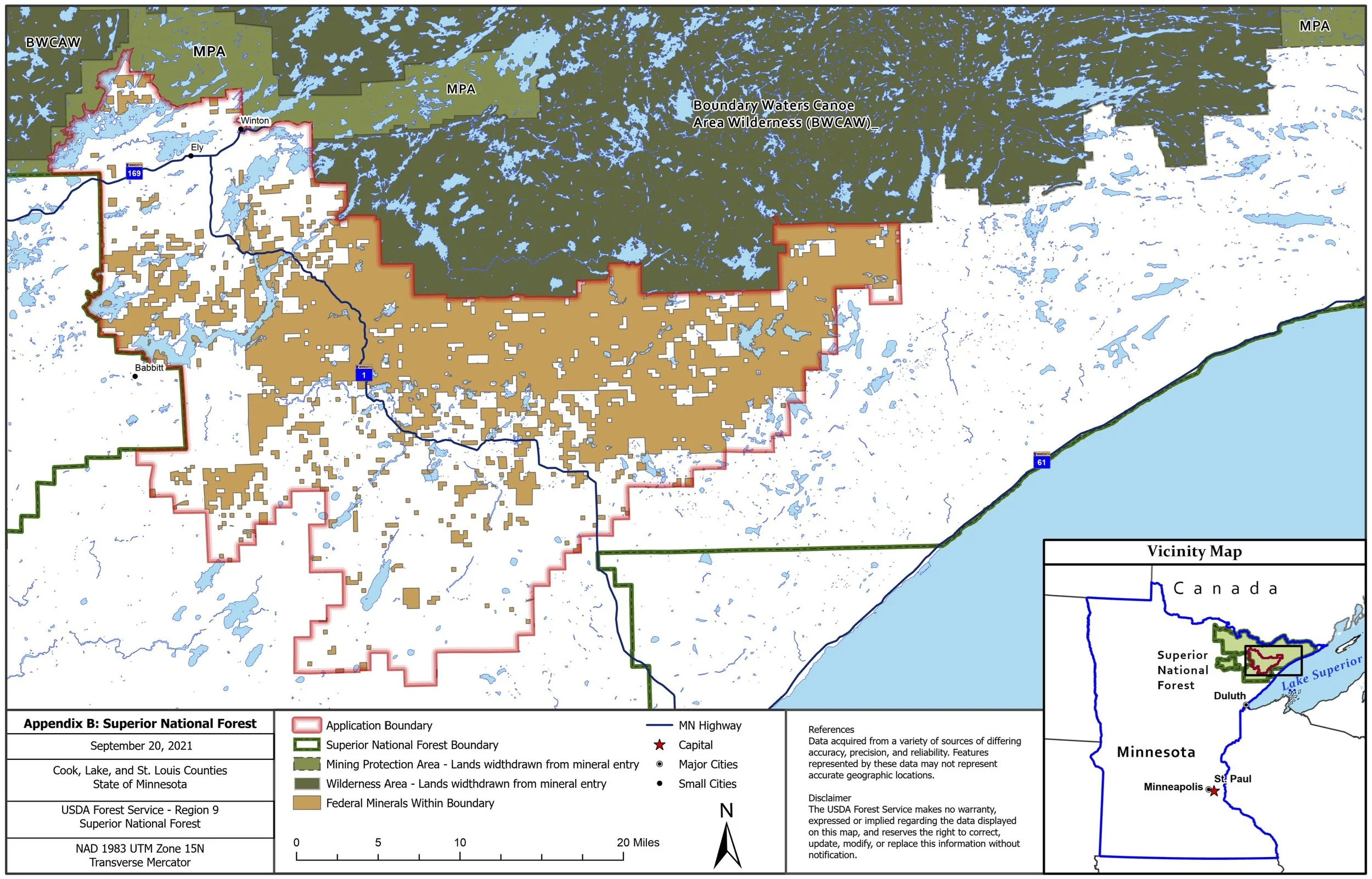
This image shows, in orange, the federal lands in the Rainy River-Headwaters Watershed (Boundary Waters watershed) that were withdrawn from mineral leasing/mining in 2023 for 20 years by PLO 7917, and which were reopened to mineral leasing by passage of HJ Res 140.
