
Upper Mississippi River Chapter Creel and Use Survey Report
By Brett Welch
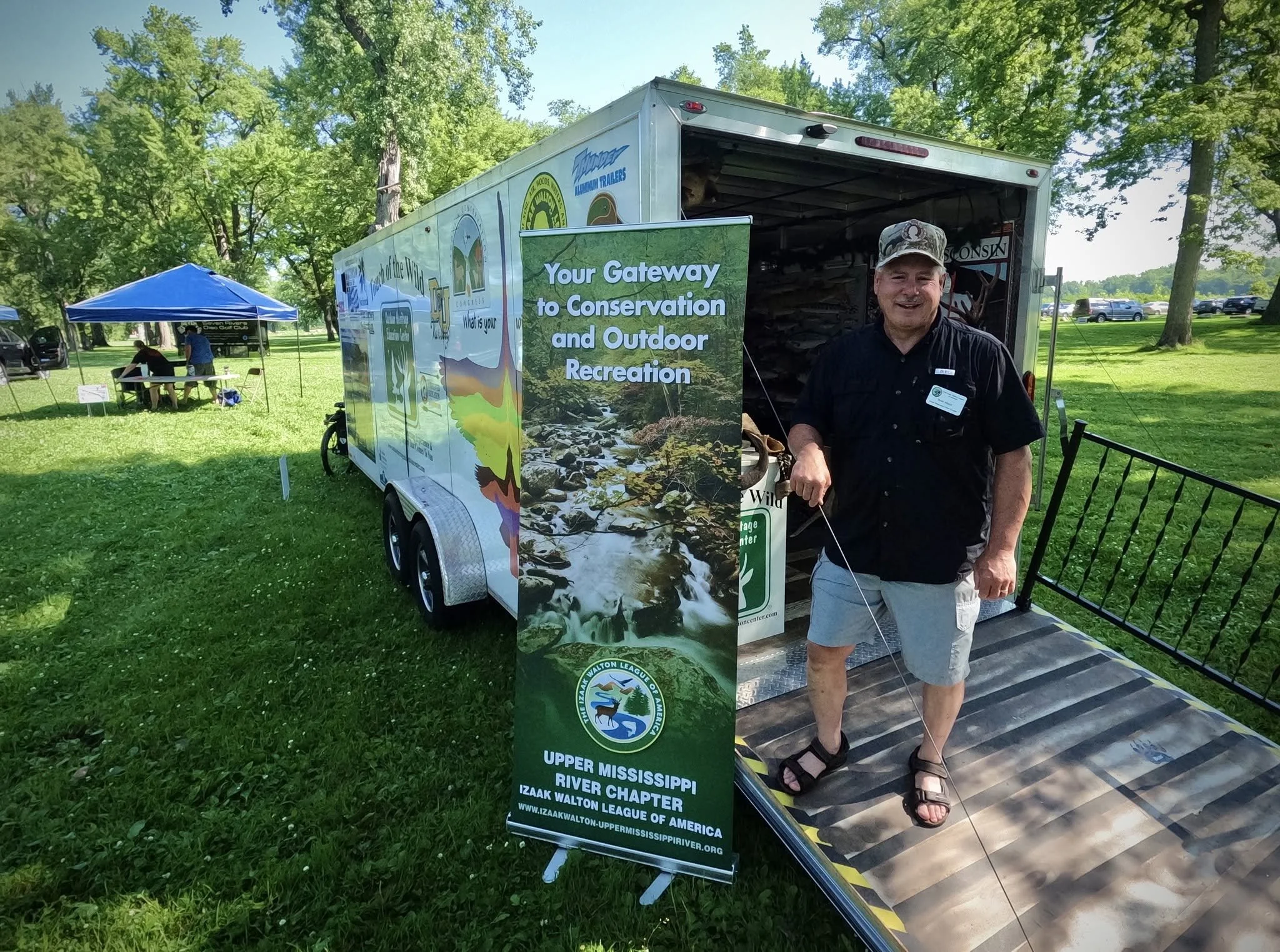
Hello everyone. My name is Brett Welch, and I am proud to be a founding member of our chapter in the La Crosse, Wisconsin, area. As a relatively new chapter, we are still developing activities that engage our members and contribute to conservation on the big river. This past winter, I began thinking about an activity that would meet those goals.
An activity that nearly anyone could participate in.
An activity that would bring public awareness to our organization and mission.
An activity suitable for One Mississippi’s River Days of Action, is held annually from June 1 through June 15.
An activity that would let participants know they were contributing to our conservation efforts.
An activity that would be repeatable and could grow in scale.
An activity with minimal cost.
I attended several agency meetings where fisheries biologists discussed past and present work on the river. I also did some research on my own and learned that agency staff rely primarily on netting and electroshocking to track the state of our fishery. Because I worked for the Wisconsin DNR in the mid-1980s as a creel census clerk, recording data about catch and harvest, I knew a bit about that type of work. I checked and found that there had not been a similar effort on pools 7 and 8 since 1972, when a tailwater survey was conducted.
Now, I want to be clear that in no way does that mean that our fisheries folks are not doing an outstanding job. They work hard every day at what they do, and they use education and skills that most of us don’t have. The lack of census data is largely because between these two pools there are more than 20 public boat landings and access points and many more private marinas, fishing floats and private properties. This makes such an endeavor very labor intensive and expensive to do a proper job.
I polled our membership to see if they would support such an effort, and many did. We took a vote and decided to pursue the activity. The planning began and it didn’t take long for me to realize that this was going to be, let’s say, logistically and administratively challenging. There were many people that helped create both the paper and electronic versions of the survey. There were QR codes created to place on glossy information sheets directing folks to our chapter’s web site as well as the electronic survey. There were in some cases special use permits and officials to communicate with to make clear what and when we were going to do this. There were some costs as well. We were able to get high visibility vests with our logo for our volunteers as well as clip boards and supplies.
After a brief training session, supported by an FAQ page for common survey questions and fish identification information, we were ready to begin. Volunteers signed up for four-hour shifts at public landings throughout the two pools during the first two weeks of June. Weather disrupted some planned survey periods, and one member became ill and could not complete his scheduled shifts. In the end, we collected 93 surveys—a good start, but not enough to draw conclusions. More work remains to be done.
We had a chapter meeting just the other day and it turns out that some are willing to continue the effort, so we will be headed back out to talk with fellow river rats, and we are thinking of inviting other Ike’s chapters and NGOs to join our effort next June. Where this goes from here is up to us.
I would like to extend a special Thanks to the following people, without them this effort would not be possible.
Betty DeBoer: Professor Emeritus and survey expert – Worked tirelessly to create our survey
Emmy Monroe: Biologist and technical advisor – Worked to create our electronic survey as well as our information cards
Fritz Funk: Fisheries biologist – aided in research for the project
Mike Brown: Retired Educator and liaison to KAMO- Co-chair and survey coordinator
Timothy Hill: Retired Educator - Co chair
John Sullivan: Biologist – advised on the project
To all our volunteers that gave of their time, and to all of our agency folks that gave their time and knowledge, thank you.
